What's Wrong With My Tomato Plant? A Triage Guide
- What is wrong with my tomato plant?
- Where should you look first?
- Are the oldest leaves spotted, yellow or rolled?
- Does distorted new growth change the priority?
- What does wilting tell you about water?
- Is fruit damage at the blossom end or somewhere else?
- Is something eating the leaves?
- Which changes can be normal, and which need prompt help?
- How do you make a useful comparison across the bed?
- What should you send to extension or a plant clinic?
- What should you avoid while the cause is uncertain?
- Sources
What is wrong with my tomato plant?
Start with where the damage appears: older leaves, new growth, stems, fruit or the whole plant. Then record its shape, speed and distribution, and check soil moisture before adding water or fertilizer. These observations narrow the possibilities; they do not confirm a disease. Rapid decline, suspected herbicide exposure or spreading blight-like lesions need prompt local extension or plant-clinic advice before treatment.
A useful first inspection ends with a better question, not necessarily a diagnosis. “Three plants have spots on their oldest leaves” gives a specialist more to work with than “my tomatoes are dying.” It also helps you choose the right detailed guide.
University of Minnesota Extension's tomato diagnostic tool begins with plant parts and symptoms. The approach below adds a practical recording system and stop points. It is a research-based starting guide, not a laboratory result, pesticide prescription or assessment of whether damaged fruit is safe to eat.
Where should you look first?
Before removing leaves, photograph the plant in place. Then follow this observation route. Record more than one row when necessary: a plant can have damaged fruit and a separate leaf problem.
| Where damage appears | Record this distinction | Next useful check |
|---|---|---|
| Older, lower leaves | General yellowing, individual spots, or rolled edges? | Photograph a representative leaf and compare newer foliage |
| Youngest leaves | Normally shaped but pale, or twisted and unusually narrow? | Record recent exposures and compare nearby plants |
| Stems and soil line | Small bumps, an injury, dark tissue or collapse? | Photograph without peeling or cutting the stem |
| Fruit | Blossom end, stem end, exposed side or scattered lesions? | Include both ends and the surrounding foliage |
| Whole plant | One branch or all branches; temporary or persistent wilt? | Check root-zone moisture and record time of day |
| Missing leaf tissue | Fine holes or stripped sections? | Look for insects, feeding traces and droppings |
This is our observation worksheet, not a table of confirmed diagnoses. Its value is in separating things that a single close-up can make look alike.
Keep your first description literal. Write “brown circles with pale centers” before writing a disease name. You can add an interpretation later without losing the original evidence.
Are the oldest leaves spotted, yellow or rolled?
Yellow is a color, not a fertilizer recommendation. Look for features within the yellow area and note whether the rest of the plant is growing normally.
University of Maryland Extension's tomato key distinguishes larger early-blight lesions with target-like rings from Septoria's small, round, pale-centered spots with dark margins. Both can begin on lower leaves and occur together. That overlap matters: a photograph may suggest the next investigation without settling it.
Use our early-blight versus late-blight comparison when spots or expanding blotches are involved. Do not assume every yellow lower leaf belongs to either disease.
For firm, upward-rolled lower leaves, Minnesota's disorders guide describes physiological leaf roll, which does not noticeably reduce growth or yield. This is different from declaring all curled plants harmless. Check for stunting, lesions and abnormal new growth, then follow our tomato leaf-curl guide for the fuller comparison.
Does distorted new growth change the priority?
It should change what you investigate. Photograph the growing tip and nearby plants before applying anything.
Maryland Extension's herbicide-injury guidance describes twisted, small, straplike young leaves following some herbicide exposures. It also warns that herbicide damage can resemble environmental, insect, mite and disease problems. Several plant types affected together are a reason to investigate exposure, not proof of its source.
Record recent weed-control work, product names if known, and additions of compost, manure or mulch. Keep the timeline factual; do not accuse a neighbor on the strength of leaf shape.
If exposure is plausible, contact extension or the relevant pesticide authority for assessment and guidance about affected produce. Do not serve it while that question is unresolved. This guide offers no chemical neutralizer, recovery spray or waiting period that clears an unknown exposure.
What does wilting tell you about water?
First check the soil rather than watering automatically. Maryland's wilting guidance explains that drought and poorly drained, waterlogged soil can both produce wilt. In saturated soil, roots can lack the oxygen they need. Hot weather can also cause temporary wilt even when soil moisture is adequate.
Look below a dry surface crust, without damaging roots, and record whether the soil is dry, moist or saturated where you checked. For a container, note drainage, recent watering and whether one plant differs from otherwise similar pots.
An important correction: recovery at night does not rule out disease. Minnesota's Fusarium wilt guide describes early daytime wilt with nighttime recovery, sometimes accompanied by uneven or one-sided yellowing. It recommends sample confirmation because Fusarium can be confused with Verticillium wilt.
Persistent or recurring wilt, asymmetric yellowing or stem damage deserves diagnostic help. Do not peel the stem or uproot a valuable plant just to imitate a photograph; ask the receiving clinic which material it needs first.
Is fruit damage at the blossom end or somewhere else?
Locate the blossom end, opposite the stem attachment, before choosing a remedy.
Blossom-end rot can produce a tan-to-black flattened area there. It involves inadequate calcium in developing fruit, but that does not establish a shortage of calcium in the soil. Moisture fluctuations, root injury and other growth conditions can affect calcium uptake. Our blossom-end rot guide covers moisture management and test-based amendments.
A pale, papery patch on the sun-facing side fits a different investigation: Minnesota describes that pattern under sunscald. Photograph the surrounding leaf cover as well as the fruit.
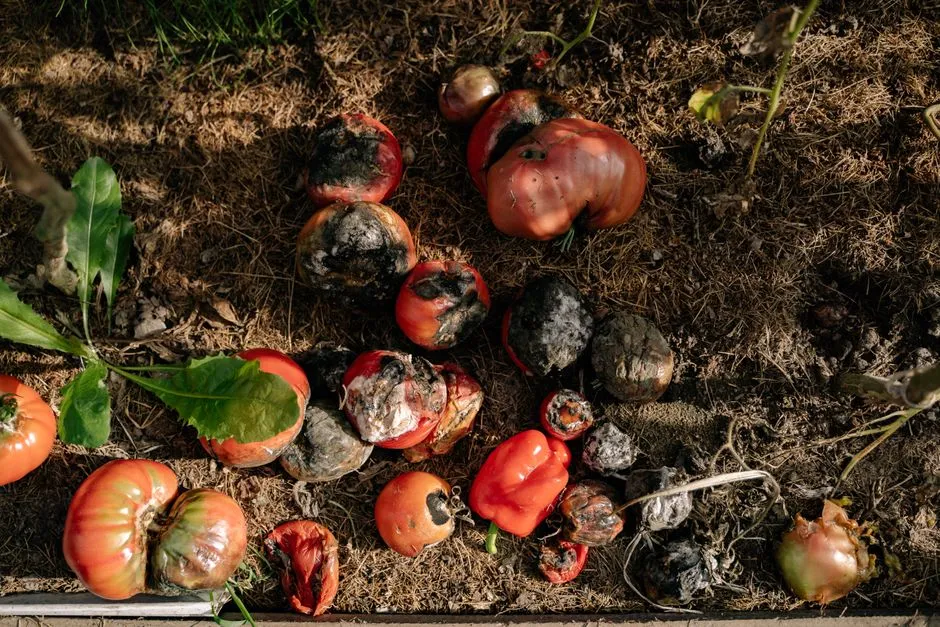
Record cracks, holes and scattered spots separately. “A damaged tomato” is not specific enough to justify either a nutrient addition or a disease treatment. Do not use a fruit symptom to explain unrelated leaf damage unless the evidence supports the connection.
Is something eating the leaves?
Missing tissue calls for a search for feeding evidence, not an automatic fungicide application.
Minnesota Extension's hornworm guide describes feeding high on the plant, substantial leaf loss and dark green or black droppings. The caterpillars can blend into the foliage. Inspect stems and both leaf surfaces near the damage, and photograph the insect if you find one.
There is a useful exception to indiscriminate removal: white, rice-shaped structures projecting from a hornworm can be parasitoid wasp cocoons. Minnesota advises leaving those hornworms so the adult wasps can emerge.
Do not identify every hole as hornworm damage. Compare the insect with a reliable identification guide, or submit a clear image. This triage article contains no pesticide-mixing or spraying instructions.
Which changes can be normal, and which need prompt help?
Small stem bumps are not automatically rot. Maryland's tomato key identifies small adventitious-root bumps as generally harmless. Photograph them and look at overall growth rather than scraping them off.
By contrast, rapidly expanding dark blotches, stem lesions and widespread decline require prompt assessment. Minnesota's late-blight guidance describes a disease affecting leaves, stems and fruit that can spread rapidly under favorable conditions. A possible outbreak warrants local advice; it is not confirmed by the word “blight” in a search result.
Our editorial escalation rule is to contact extension promptly for rapid spread, plant collapse, possible herbicide exposure or symptoms that do not fit a coherent pattern. Use regional disease information and the adviser's sampling instructions. Do not transfer another state's occurrence frequency or pesticide recommendation to your garden.
How do you make a useful comparison across the bed?
Number the plants in a sketch. Record what you examined, including unaffected plants, so a specialist can see the distribution.
For example, this fictional record is more informative than a diagnosis guessed from one leaf:
Bed A contains eight tomatoes. Plants 2, 3 and 4 have spotted lower leaves; the other five were inspected and no spots were seen. New leaves look normally shaped. Plant 7 wilted in the afternoon, with moist soil at the checked location, and has no visible spots. Photographs were taken before any new treatment.
That is three spotted plants out of eight examined, plus a separate wilt observation. It does not prove the spots are contagious or that plant 7 has the same problem. Shared location is context, not a demonstrated cause.
Add the date, weather, irrigation changes and whether the pattern is expanding. Repeat photographs from the same position if you monitor a stable issue. Do not use a monitoring exercise to delay contacting an adviser about rapid decline.
What should you send to extension or a plant clinic?
Ask the clinic before collecting or mailing material. The University of Minnesota Plant Disease Clinic recommends symptomatic plants that are still alive; its collection and packaging instructions differ by sample type. Other laboratories have their own requirements, fees and geographic restrictions.
Our suggested first message includes:
- Your location, planting date and cultivar, if known.
- Bed or container details and a whole-plant photograph.
- Close-ups of both leaf surfaces, stems and affected fruit.
- The first observed symptom and how it has changed.
- Watering, rainfall, fertilizer and amendment history.
- Products recently used and possible exposure concerns.
- A simple map showing affected and inspected unaffected plants.
Label an unknown honestly. “Cultivar unknown” is more useful than a guessed resistance claim. If the adviser requests roots or stem tissue, follow those instructions rather than substituting another handful of dead leaves.
For recently planted tomatoes, include the transplant's outdoor transition and local weather. Our planting-time guide explains why frost risk and actual conditions matter more than a zone number alone.
What should you avoid while the cause is uncertain?
Avoid several simultaneous remedies. Adding fertilizer, changing irrigation and spraying on the same afternoon leaves you unable to describe which intervention preceded the next change. Correct an observed maintenance problem, document it, and get advice when the cause remains unclear.
Do not apply a pesticide on an unconfirmed guess. If a qualified local adviser recommends one, follow the complete current label for the crop, problem and jurisdiction, including protective equipment, reentry and preharvest requirements.
Keep plant diagnosis separate from preservation safety. USDA's tomato-canning guide calls for firm, disease-free fruit and excludes tomatoes from dead or frost-killed vines. Use a complete research-tested preservation process; this symptom guide is not permission to can questionable fruit.
The useful result of triage is a clear next action: investigate a specific pattern, correct a documented growing-condition problem, or obtain professional identification. You do not need to name every tomato disease to make that first decision well.
Sources
- University of Minnesota Extension: tomato symptom selector.
- University of Maryland Extension: common tomato problems.
- University of Minnesota Extension: tomato disorders.
- University of Maryland Extension: herbicide damage.
- University of Maryland Extension: wilting vegetables.
- University of Minnesota Extension: Fusarium wilt.
- University of Minnesota Extension: tomato hornworms.
- University of Minnesota Extension: late blight.
- University of Minnesota Plant Disease Clinic: sample submission.
- USDA: selecting, preparing and canning tomatoes.